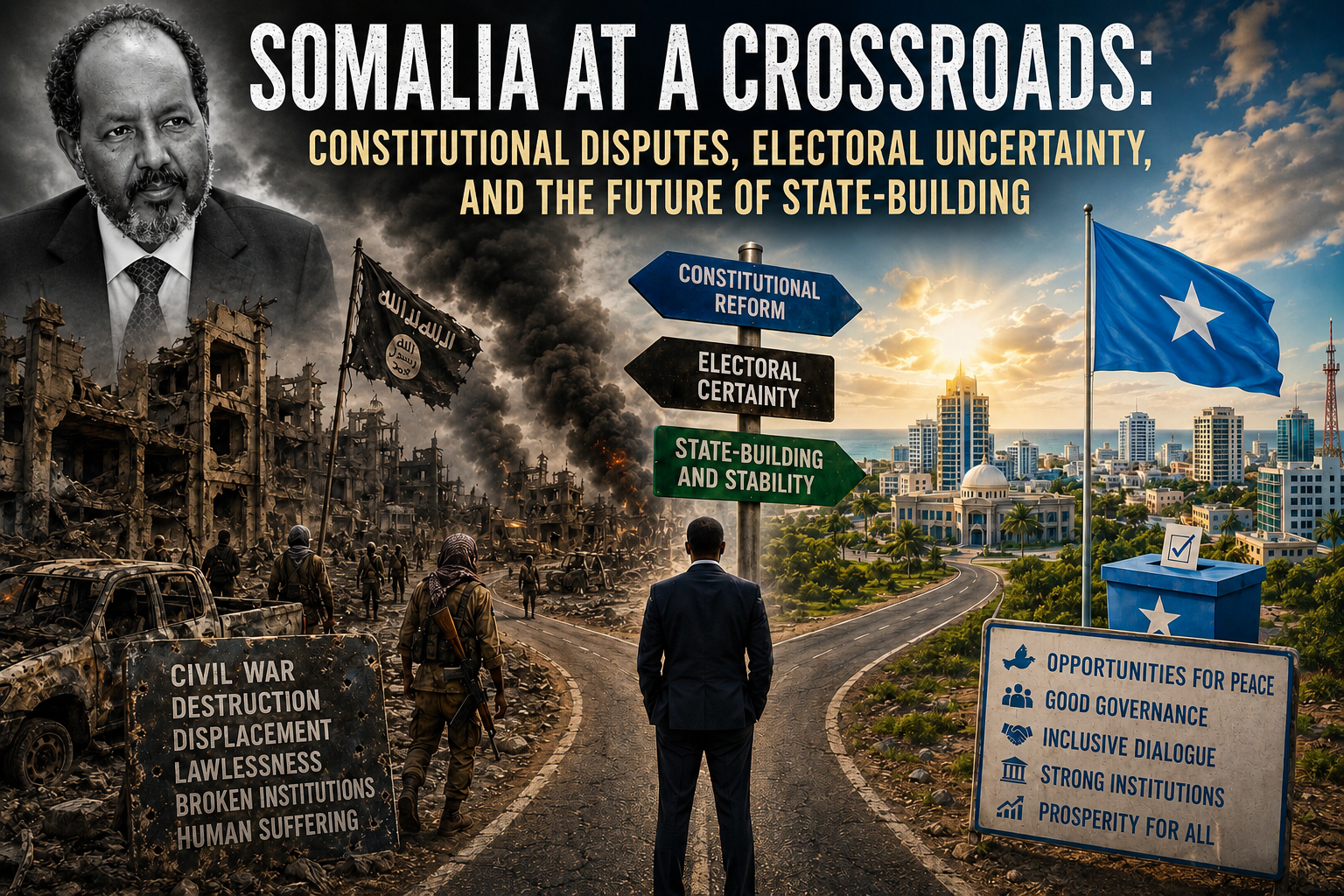
Somalia at a Crossroads: Constitutional Disputes, Electoral Uncertainty, and the Future of State-Building
By Dr. Asad Khalif Aliweyd
Sunday June 14, 2026
Somalia stands at a critical political crossroads. While the country has made significant progress in rebuilding state institutions since the collapse of the central government in 1991, unresolved constitutional disputes, uncertainty surrounding elections, and growing tensions between federal and regional leaders threaten to undermine these gains. The challenges facing Somalia today are not merely political disagreements; they are symptoms of deeper institutional weaknesses that continue to hinder the country’s transition toward a stable and effective democratic state.
The findings presented in my book Rebuilding Somalia: A Journey of Resilience, Reform, and Renewal highlight the importance of administrative capacity as the foundation of state-building. Drawing upon Honadle’s framework for administrative capacity, the book argues that stable governance requires institutions capable of anticipating change, developing effective programs, managing resources, evaluating performance, and applying lessons learned. These principles are especially relevant to Somalia’s current political situation.
One of the most pressing issues facing Somalia is the ongoing dispute over the provisional constitution. More than a decade after its adoption in 2012, key constitutional provisions remain unresolved. Questions regarding the distribution of powers between the Federal Government and Federal Member States, the structure of the judiciary, resource-sharing arrangements, and the electoral system continue to generate political conflict. Without constitutional clarity, governance remains vulnerable to competing interpretations and political maneuvering.
The uncertainty surrounding the end of the current presidential term further complicates the political environment. Somalia’s leaders face increasing pressure to provide a clear electoral roadmap and timetable that is accepted by all major stakeholders. Delays or disagreements regarding electoral processes risk creating a constitutional vacuum that could undermine public confidence and trigger political instability. Somalia’s recent history demonstrates that disputes over elections can quickly escalate into broader security and governance crises.
The absence of a widely accepted election timeline presents significant risks. Political uncertainty discourages investment, weakens international confidence, and diverts attention from critical national priorities such as economic development, security reform, healthcare, and education. It also creates opportunities for extremist groups such as Al-Shabaab to exploit political divisions and undermine public trust in government institutions.
Another major challenge is the continued politicization of public administration. As highlighted in the book, many participants emphasized the need to strengthen merit-based recruitment, professional civil service systems, and institutional continuity. Frequent leadership changes and political interference weaken administrative effectiveness and reduce the government’s ability to deliver services consistently. Building strong institutions requires moving beyond personalities and political alliances toward systems that endure regardless of changes in leadership.
Despite these challenges, Somalia also faces important opportunities. The ongoing constitutional review process provides an opportunity to establish a more durable federal framework capable of reducing future conflicts. If conducted inclusively and transparently, constitutional reforms can strengthen national unity while respecting regional autonomy. Likewise, the transition toward a more democratic electoral system could enhance political legitimacy and citizen participation if accompanied by adequate preparation and consensus-building.
The book also emphasizes the importance of reducing dependence on the 4.5 clan power-sharing formula as the primary basis for governance. While the system has helped manage political competition during transitional periods, long-term state-building requires institutions based on citizenship, competence, accountability, and the rule of law. Progress toward a more inclusive and merit-based political system could help strengthen national cohesion and improve public confidence in government.
Furthermore, Somalia’s growing young population presents an enormous opportunity. Investments in education, healthcare, judicial reform, and financial institutions can create the human capital necessary for sustainable development. Effective governance and administrative capacity will determine whether this demographic advantage becomes a driver of national prosperity or a source of future instability.
Ultimately, Somalia’s future depends not only on resolving immediate political disputes but also on strengthening the institutions that support democratic governance. Constitutional agreements, election schedules, and political compromises are important, but lasting stability requires capable institutions that can implement policies, deliver services, and maintain public trust.
Somalia has demonstrated remarkable resilience throughout decades of conflict and state collapse. The current political challenges should be viewed not only as risks but also as opportunities to complete the unfinished work of state-building. By strengthening administrative capacity, promoting constitutional consensus, ensuring credible elections, and investing in professional public institutions, Somalia can move closer to achieving the vision of a stable, democratic, and prosperous federal state.
Asad Aliweyd, Ph.D., MBA
Author of Rebuilding Somalia: A Journey of Resilience, Reform and Renewal; Founder and President of the New American Development Center (NADC); 2018 Bush Fellow and Who’s Who in America Award recipient. He holds a Ph.D. in Management and Public Service and is a leader in community and economic development.